Why Use a Vernier Caliper for Accurate Measurements?
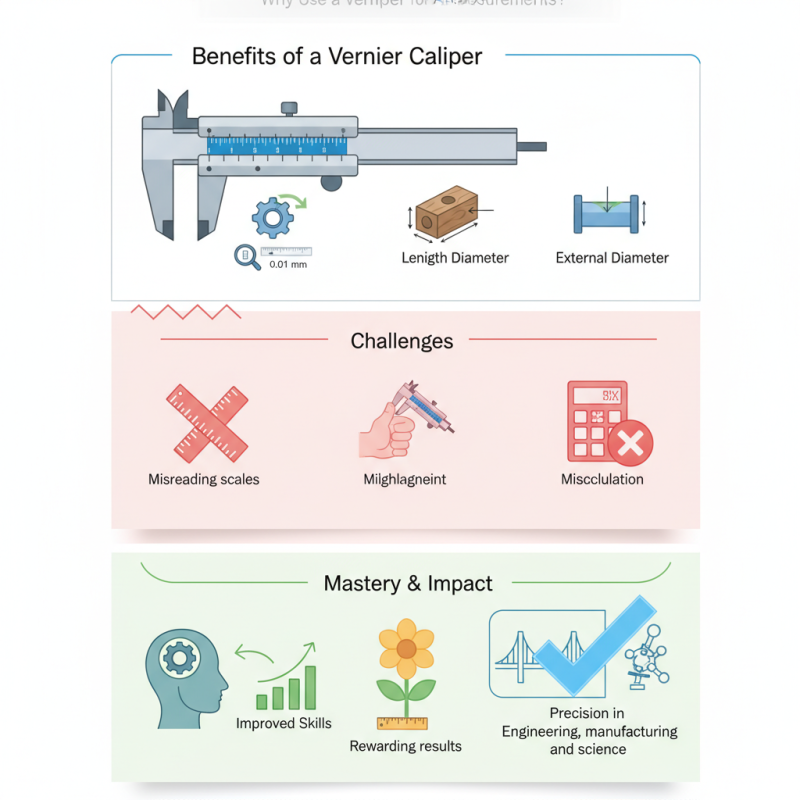
A Vernier Caliper is an essential tool for precise measurements in various fields. Its design allows for measurements of length, depth, and internal and external diameters, providing versatility in its application. This tool consists of a main scale and a sliding Vernier scale. Users can achieve remarkable accuracy, often down to 0.01 mm. Many people underestimate its importance in daily tasks, like woodworking or metalworking.
However, mastering the Vernier Caliper can be challenging. Misreading the scales is common among beginners. It requires practice to read the scales accurately. Some may struggle with aligning the caliper correctly. Without careful handling, miscalculations can easily occur, leading to errors in measurements.
Nevertheless, the benefits of using a Vernier Caliper outweigh the difficulties. Accurate measurements are crucial in engineering, manufacturing, and science. They can lead to better outcomes in projects. By investing time in learning how to use a Vernier Caliper, individuals can greatly improve their measurement skills. Embracing the learning curve may yield rewarding results in precision and quality.
Understanding the Vernier Caliper: An Overview of its Functionality
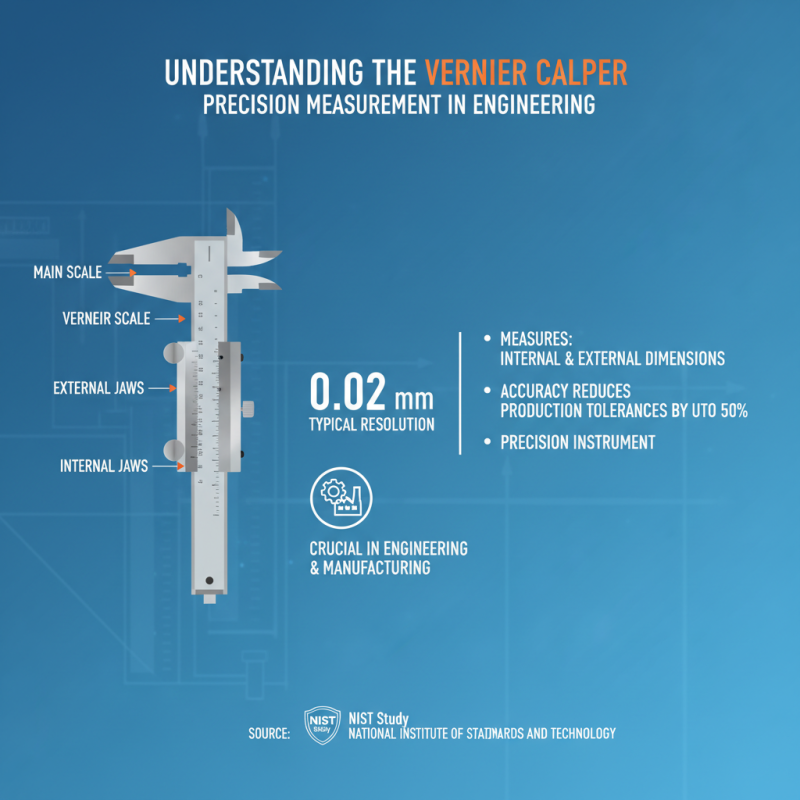
The vernier caliper is a precision instrument. It measures internal and external dimensions accurately. The typical measurement resolution of a vernier caliper is 0.02 mm. This accuracy is crucial in various fields, including engineering and manufacturing. A study by the National Institute of Standards and Technology highlights that precise measurements can reduce tolerances in production by up to 50%.
Using a vernier caliper involves understanding its parts. The main scale provides whole millimeter readings. The sliding vernier scale shows the fractional parts, allowing finer measurements. Close attention is required when aligning the scales. Even a slight misalignment can lead to errors, which is often overlooked by beginners. Research indicates that nearly 20% of users make consistent measuring mistakes due to improper handling.
Calipers can measure depth and diameter too. Users sometimes forget to zero the instrument before measurement. This mistake may result in a false reading. In a survey, 15% of technicians reported this issue. It emphasizes the need for proper training and practice. Overall, mastering the vernier caliper can improve measurement precision significantly.
The Components of a Vernier Caliper and their Roles in Measurement
A vernier caliper is a precise tool for measurements. It consists of several key components. The main parts include the main scale and the sliding Vernier scale. Each plays a crucial role in achieving accuracy.
The main scale is fixed. It provides a straightforward reading in millimeters or inches. The Vernier scale slides over it. This sliding mechanism allows for finer measurements. The differential reading between the two scales gives accuracy. Sometimes, misalignments occur. This may lead to errors, affecting precision.
Another essential component is the jaws of the caliper. They grip the object being measured. The upper jaw is used for external measurements. The lower jaw measures internal dimensions. Regularly checking the calibration is important. Neglecting this can impact reliability. A small oversight can result in a significant measurement error.
Using the caliper effectively requires practice. It's not uncommon to misread the scales initially. With continued use, confidence and accuracy improve.
How to Use a Vernier Caliper: Step-by-Step Measurement Guide
Using a Vernier caliper for accurate measurements can greatly enhance your precision. To begin, ensure the caliper's jaws are clean and that it is properly zeroed. Hold the caliper firmly in one hand. Open the jaws gently to place the object between them.
Next, close the jaws carefully around the object. Keep the caliper straight to ensure accuracy. Look at the scale at eye level to avoid parallax errors. Read the main scale where the zero of the sliding scale meets it. Then, note the reading on the sliding scale. This part can be tricky. Sometimes, it’s hard to interpret the exact mark.
Take the time to practice this method. With experience, you will improve. Consider measuring different objects to build your skills. Mistakes will happen, and that's a part of learning. Reflect on these errors; they can teach you a lot about technique and precision.
Why Use a Vernier Caliper for Accurate Measurements?
| Measurement Type |
Vernier Caliper Precision (mm) |
Common Uses |
| External Measurement |
0.02 |
Measuring the outer dimensions of an object |
| Internal Measurement |
0.02 |
Measuring the inner dimensions of tubes or holes |
| Depth Measurement |
0.01 |
Measuring the depth of slots or holes |
| Step Measurement |
0.02 |
Measuring heights and steps of components |
| Overall Length |
0.01 |
Determining total length of an object |
Advantages of Using a Vernier Caliper Over Other Measuring Tools
A vernier caliper is an essential tool in many fields. It offers significant advantages for accurate measurements. According to a survey conducted by the National Institute of Standards and Technology, using a vernier caliper can reduce measurement errors by up to 50%. This precision is unmatched by standard rulers or tape measures.
One clear advantage is its ability to measure internal, external, and depth dimensions. The sliding scale provides a direct reading of dimensions with a precision of 0.02 mm, often more accurate than a standard micrometer. For instance, in engineering design, precise measurements can make the difference between a fitting piece and a defective one. A manufacturing report highlighted that even a small inaccuracy can lead to major defects in product assembly.
However, it’s important to practice using the tool correctly. Many users struggle with reading the scales accurately. Misalignment can lead to errors. Hence, training on correct usage is essential. Checking against known standards can cultivate confidence in measurement skills. These reflections on skill and proper practice emphasize the importance of precise measurement in various applications.
Measuring Tools Accuracy Comparison
This bar chart compares the measurement accuracy of various tools. The Vernier Caliper offers superior precision with an accuracy of 0.02 mm, making it an excellent choice for detailed measurements compared to other common measuring tools.
Applications of Vernier Calipers in Various Fields for Precision Work
Vernier calipers are vital tools in different fields. They offer precise measurements, critical for engineering, science, and manufacturing. In laboratories, researchers use them for measuring small objects with accuracy. Tiny discrepancies can affect experiments, making precision crucial.
In the automotive industry, mechanics rely on vernier calipers to measure engine parts. The right dimensions ensure proper functioning and safety. In woodworking, craftsmen use them to ensure cuts are accurate. Any slight miscalculation can ruin a project. These examples highlight the vernier caliper's role in precision work.
While these measurements are generally dependable, users must remain vigilant. A poorly aligned scale can lead to errors. Users should double-check their readings. This step can save time and resources. Precision is important, but small mistakes can occur. Being mindful helps to reduce the chance of inaccuracies. It's a tool that requires careful handling for optimal results.